
 By Digi Team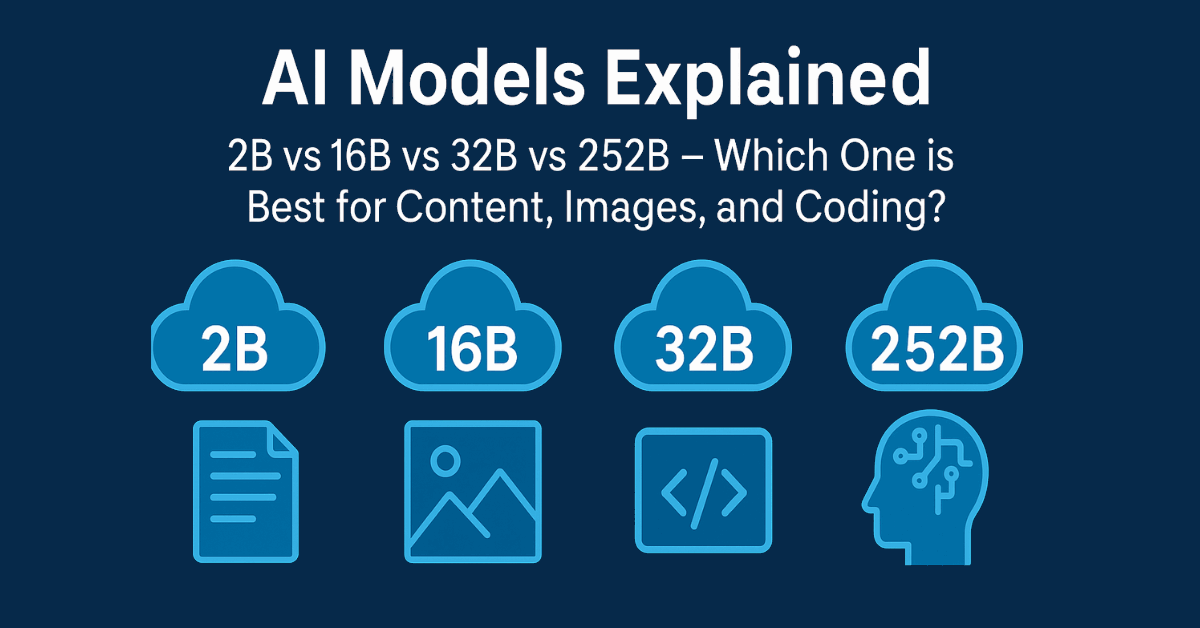
Why AI Model Sizes Matter
Artificial Intelligence (AI) is moving faster than ever. Every few months, we hear about a new AI model that’s bigger, smarter, and more capable than the last. But when people mention 2B, 16B, 32B, or 252B, what do these numbers really mean?
If you’re into AI writing, coding, image generation, or app building, understanding model sizes is essential. Bigger models often produce more human-like and accurate results—but they also require more resources. This article will help you understand the differences and decide which type of model fits your needs.
What Does “2B, 16B, 32B, 252B” Mean in AI?
The “B” stands for Billion Parameters. Parameters are the mathematical weights inside the AI model. You can think of parameters as the “knowledge switches” that help the model understand and generate language, images, or code.
- 2B = 2 Billion parameters
- 16B = 16 Billion parameters
- 32B = 32 Billion parameters
- 252B = 252 Billion parameters
Each jump in size allows the model to store more knowledge, handle more context, and generate higher-quality outputs.
Breaking Down the Differences
Here’s how different model sizes compare in practice:
1. 2B Models
- Pros: Small, lightweight, fast, runs on consumer devices, low cost.
- Cons: Limited reasoning, repetitive text, struggles with creativity.
- Best For: Chatbots, autocomplete, simple Q&A systems.
2. 16B Models
- Pros: Balance between performance and efficiency. Handles moderate coding and text generation tasks well.
- Cons: Still less nuanced compared to larger models.
- Best For: Medium-level content, blog drafts, coding small apps, summarization.
3. 32B Models
- Pros: Strong reasoning, creative writing, can generate long-form content and cleaner code.
- Cons: Slower, needs better hardware or cloud servers.
- Best For: Full blog articles, storytelling, coding projects, structured reports.
4. 252B Models
- Pros: Extremely powerful, closest to human-level intelligence in creativity, reasoning, and long memory. Handles multimodal tasks (text, images, code).
- Cons: Very expensive, requires clusters of GPUs, mostly used by tech giants.
- Best For: Professional-grade humanized content, realistic image generation, designing apps, research-level coding tasks.
Real / Estimated Parameter Counts of Popular Models
| Model | Parameter Count | Source / Confidence | Notes |
|---|---|---|---|
| LLaMA 3 (Meta) | 8B, 70B, 405B | High confidence (Reuters) | Models released in those sizes. 8B & 70B publicly, 405B is the large “dense” version. (arXiv) |
| LLaMA / LLaMA-2 | 7B, 13B, 33B, 65B, 70B | Confirmed (arXiv) | Earlier versions: LLaMA-1 had 7B, 13B, 33B, 65B. LLaMA-2 came in 7B, 13B, 70B. (The Indian Express) |
| GPT-3 | ~175B | Confirmed (arXiv) | Dense transformer model. (arXiv) |
| GPT-4 | ~1.7-1.8 Trillion (1.7-1.8T) | Estimated / Leaked (Exploding Topics) | OpenAI hasn’t officially confirmed the full parameter count. These estimates are from leaks/analysis of “Mixture of Experts” versions. (Exploding Topics) |
| GPT-4o Mini | ~8B | Estimated / Leaked (Exploding Topics) | A lighter inference version; good for less demanding tasks. (Claude) |
| Claude models | Some estimates: Claude 3 Haiku ~20B, Claude 3 Sonnet ~70B, Claude 3 Opus ~2T | Low-to-Medium confidence (Claude) | These are unconfirmed leaks. Use cautiously. (Claude) |
| Gemini Ultra (Google) | ~1.56T (rumored) | Low confidence / Rumor (Reddit) | No official confirmation. (Reddit) |
How to Use These in Your Article
| Model | Parameter Size | Strengths | Best For / Use-Cases |
|---|---|---|---|
| LLaMA 3 8B | 8 Billion | Lightweight, faster inference, lower cost | Local content, prototypes, less resource-intensive tasks |
| LLaMA 3 70B | 70 Billion | Much better reasoning, more context, better code quality | Medium-to-large text generation, coding helpers |
| LLaMA 3 405B | 405 Billion | High performance, long context, very strong in many benchmarks | High-end content, code + research, near state-of-art tasks |
| GPT-3 (175B) | 175 Billion | Still very strong baseline, widely used | Chatbots, many content tasks, code |
| GPT-4 (≈1.7-1.8T est.) | ~1.7-1.8 Trillion | Best of current generation in reasoning, multimodal, code, creative generation | “Flagship” tasks, heavy depth, best humanization etc. |
| Claude 3 Sonnet / Opus (estimates) | 70B / ~2T | Possibly competing in similar high-end tasks if estimates hold | Use these as speculative comparisons; good for showing the frontier |
Which AI Model is Best for Humanized Content?
When it comes to creating blogs, stories, essays, and natural-sounding conversation, bigger is better.
- A 2B model often sounds robotic.
- A 16B model is okay for drafts.
- A 32B model produces human-like, polished text.
- A 252B model gives the most natural, emotional, and context-aware writing—almost indistinguishable from humans.
If you’re serious about content marketing, blogging, or SEO writing, aim for at least a 32B model.
Which AI Model is Best for Realistic Images?
AI image generation depends not only on size but also on architecture. However, larger multimodal models do significantly better at turning text prompts into realistic, detailed images.
- 2B/16B image models → Struggle with realism, anatomy, and text in images.
- 32B models → Create decent, artistic images.
- 252B multimodal models (like GPT-4V or Gemini Ultra) → Generate highly realistic, accurate, and creative visuals.
For designers, eCommerce stores, and creative industries, a 252B multimodal model is the best choice.
Which AI Model is Best for Coding and Apps?
AI coding assistants are becoming powerful tools for developers.
- 2B models: Can generate simple snippets but often buggy.
- 16B models: Write workable scripts and functions but may struggle with architecture.
- 32B models: Clean code, debugging help, can build small-to-medium apps.
- 252B models: Best for full application design, handling frameworks, suggesting optimizations, and complex multi-step coding tasks.
If you want to build apps with AI, go with 32B or higher.
Size Isn’t Everything: Training and Fine-Tuning Matter
One important thing to remember: bigger doesn’t always mean better.
A well-trained 13B model (like LLaMA 2–13B) can outperform an older 175B model if it’s optimized properly. Quality of training data, fine-tuning, and safety alignment are just as important as size.
Hardware and Cost Considerations
Running these models also requires resources:
- 2B → Runs on laptops and even phones.
- 16B → Needs a single GPU or strong CPU.
- 32B → Requires multiple GPUs or cloud AI services.
- 252B → Only runs on massive server clusters (think OpenAI, Google, Anthropic).
If you’re an individual or small business, cloud AI services are more practical than running huge models locally.
Future Trends in AI Model Sizes
AI is shifting towards smaller but smarter models. With techniques like quantization, pruning, and distillation, researchers are shrinking model sizes without losing much performance.
This means in the near future, a 10B model could perform almost as well as today’s 100B+ giants—making advanced AI more accessible.
Practical Advice: Which Model Should You Use?
- For bloggers & marketers → 32B models (best mix of cost and quality).
- For designers & creatives → 252B multimodal models for real images.
- For developers → 32B models or above for clean coding and app design.
- For hobby projects → 2B or 16B models are cheap and good enough.
Conclusion
The difference between 2B, 16B, 32B, and 252B models comes down to scale and capability. Small models are fast and cheap, but large models deliver human-like creativity, realistic images, and professional-grade coding.
In short:
- Use 2B/16B if you need efficiency.
- Use 32B if you need high-quality writing and coding.
- Use 252B if you want the absolute best AI available today.
As AI evolves, expect future models to deliver more power at smaller sizes—making world-class AI accessible to everyone.
FAQs
1. What do 2B, 16B, 32B, and 252B mean in AI models?
They refer to the number of parameters in the model, measured in billions (B). Parameters are the trainable weights that allow an AI to process data and generate outputs. For example, a 2B model has 2 billion parameters, while a 252B model has 252 billion.
2. Is a bigger AI model always better?
Not always. While larger models usually have more reasoning power, creativity, and accuracy, a smaller well-trained model (like LLaMA 3 70B) can outperform an older large model (like GPT-3 at 175B). Quality of training data, fine-tuning, and architecture matter as much as size.
3. Which AI model size is best for writing human-like content?
For natural, humanized content, 32B models and above are recommended. They handle context better and generate smoother, more natural language compared to smaller models.
4. Which AI model size is best for generating images?
Multimodal models with larger parameter counts (such as 252B+) perform best in generating realistic and detailed images. Smaller 2B or 16B image models often struggle with realism and fine details.
5. Which AI model size is best for coding?
- 2B models: Basic snippets, limited accuracy.
- 16B models: Decent scripts and functions.
- 32B models: Clean code, structured projects, debugging.
- 252B models: Complex app development, optimization, multi-framework support.
6. Can I run a 252B model on my computer?
No. Models this large require clusters of high-end GPUs or TPUs, usually only available to companies like OpenAI, Google, or Meta. Individuals can access them through cloud services or APIs.
7. What is the smallest AI model I can run locally?
You can run 2B–7B models on a modern laptop or desktop with sufficient RAM (16GB+). These are good for lightweight tasks like autocomplete or small chatbots.
8. Does parameter size affect AI speed?
Yes. Smaller models (2B–16B) are faster and cheaper to run, but may sacrifice accuracy. Larger models (32B–252B) are slower and more resource-intensive but produce higher-quality results.
9. What is the difference between parameters and context length?
- Parameters = the brain size (knowledge and ability).
- Context length = how much information the model can remember in a single session.
A model may have billions of parameters but a short memory, or vice versa.
10. What is the future of AI model sizes?
AI research is moving towards smaller but smarter models. Techniques like quantization, pruning, and distillation allow smaller models to achieve near large-model performance, making AI more accessible without needing massive hardware.